
By the MeetAndPlay editorial team · · 6 min read
What's your padel level? Take the test in 2 minutesIn this guide
Use this image
Copy this HTML to publish the diagram on your site. It includes the credit link to the guide.
A padel court looks small next to a tennis court, and it is. But its size, walls and lines are not a detail: they decide how the game is played, where you should stand and why the ball comes back off the glass. This guide sums up the dimensions of a regulation court according to the International Padel Federation (FIP) and explains what each part means once you are standing in it.
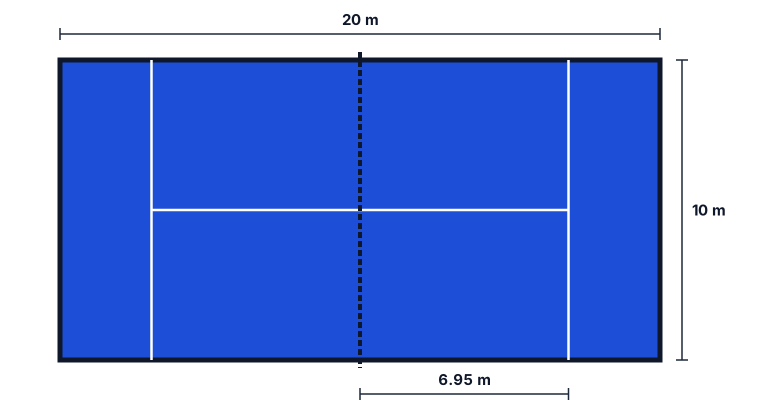
The size: 20 by 10 metres
A padel court is 20 metres long and 10 metres wide. These are the original measurements of the sport and they are still the standard: when someone says "regulation court", this is the rectangle they mean. It is far smaller than a tennis court, which is why a doubles match has long rallies and constant pace in little space.
The net splits it in half, so each pair defends a side of 10 by 10 metres. Two people fit in that square if they move together, step up and back at the same time and cover the space without big gaps.
The net
The net is a single span hung between two posts, as in tennis. According to the FIP its height is 88 centimetres at the centre and slightly more at the ends, next to the posts, where it reaches about 92 centimetres. It is lower than a tennis net, which is why the volley and the smash are played so close to it.
The service line
A line runs parallel to the net, 6.95 metres from it on each side. Between the net and that line sit the two service boxes, and a centre line divides each half in two. The serve, hit below the waist after bouncing the ball, has to land in the diagonally opposite box. A serve that bounces before that line or outside the correct box is a fault.
For a first-time player this line is also a practical reference: the zone between the service line and the net is where you attack; the zone between the service line and the back wall is where you defend.
The walls: back, side and mesh
What makes padel unique is that the ball can be played after it bounces off the walls. The walls come in three parts:
- Back walls. Three metres of tempered glass (or concrete), with another metre of mesh on top: four metres in total. The ball bounces cleanly off the glass, which is why you can return almost anything that hits it.
- Side walls. They close the sides and combine glass with stretches of metal mesh. Along the side the glass height changes: it is taller near the back and lower near the net, with mesh completing the height above.
- Metal mesh. It closes the court above the glass and at the sides. A ball that hits the mesh bounces far less predictably than off the glass, which is why almost everyone learns not to play balls that hit the mesh on their own side.
The court also needs free height above the floor for lobs, generally around 6 metres. That is one reason covered courts have to be tall buildings, and why not just any warehouse works as a court.
Glass or concrete
There are two kinds of wall. Tempered glass is the most common in modern clubs and gives a regular bounce. Concrete or solid walls appear on older or low-cost courts. The bounce off concrete is slower and feels different: the ball loses more speed on impact. If you play on both, defending feels easier on glass and heavier on concrete.
The floor: artificial turf with sand
Most courts have artificial turf with sand spread between the fibres. That sand controls ball speed and shoe grip. An old surface compacts the sand and the ball comes off faster; a wet one is slippery. So besides checking the dimensions, it is worth looking at the floor before you book. If you need proper footwear, see our guide to shoes for padel, tennis and pickleball.
Covered or open
A court can be outdoors, covered or inside a building. The dimensions are the same; what changes is the weather: direct sun and rain on an open court, shade and artificial light on a covered one. Where it is very hot or rains often, a covered court lets you keep your playing slot without cancelling.
How to use these measurements in your game
Knowing the court is 20 by 10 is not trivia. It helps you play better:
- Keep about two metres from the net when you attack. If you step up, step up with your partner; if you drop back, you both do.
- Let the ball bounce off the back wall. The back wall is far, but the rebound returns to your zone. Waiting a moment gives you the ball face on.
- Use the service line as a mental limit. Between that line and the net, you control the ball; behind it, you defend.
- Do not fight the mesh. If a ball is going to hit the mesh on your side, let it go.
One size worldwide
Although padel is played in many countries, the court is the same everywhere. A court in Cancún measures the same as one in Madrid or Buenos Aires, which makes playing on holiday easy: you arrive, book and already know how the ball moves. To find a place, start with our padel courts and compare the clubs in your city.
In short
Twenty by ten metres, a net 88 centimetres high at the centre, a service line at 6.95 metres, glass or concrete walls and mesh above. With those numbers in your head, you can see why padel is played in pairs, why the rebound is part of the game and why it is so easy to get hooked from the first match.
When you are ready to put it into practice, open MeetAndPlay, find a match at your level in the city you are in and reserve your spot on court.
Frequently asked questions
- How big is a padel court?
- A regulation court is 20 metres long and 10 wide. The net splits it into two halves of 10 by 10 metres, one for each pair.
- How high is the padel net?
- According to the FIP the net is 88 centimetres at the centre and slightly higher, about 92 centimetres, at the ends next to the posts.
- How far is the service line from the net?
- 6.95 metres on each side. The serve has to land in the diagonally opposite box.
- Can padel courts be a different size?
- For regulation play, no: the measurement is 20 by 10 metres worldwide. Smaller recreational courts exist, but they are not regulation.
- Where can I find padel near me?
- Use your location to see the closest padel places, or browse the padel page with every city in Mexico.
Where to find padel near me
Use your location to see the closest padel places, or browse the padel page with every city in Mexico.