
By the MeetAndPlay editorial team · · 7 min read
In this guide
Use this image
Copy this HTML to publish the diagram on your site. It includes the credit link to the guide.
A tennis court is the largest of the racket courts played in Mexico, and its size does not change from one club to the next. Whether you play at a private club in Monterrey, a public sports centre in Mexico City or a hotel in Cancún, a regulation court measures the same. This guide sums up the official dimensions from the International Tennis Federation's (ITF) Rules of Tennis, explains what each line is for and how much room a court needs around it.
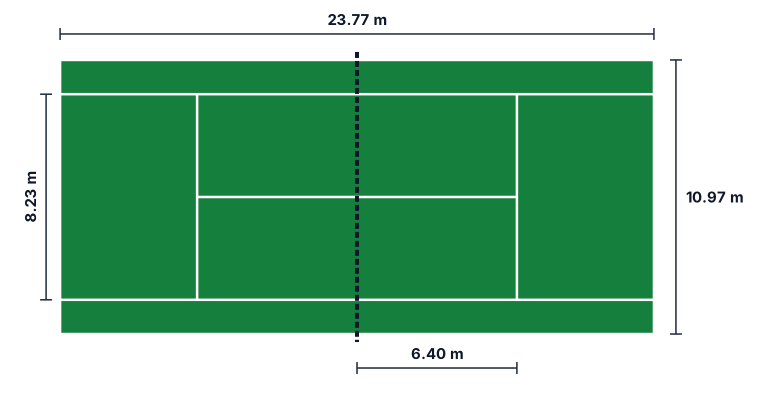
The size: 23.77 metres long
A tennis court is a rectangle 23.77 metres long. The figure comes from the imperial units the game was first defined in: exactly 78 feet. The length is the same for singles and doubles; what changes is the width.
- Singles: 8.23 metres wide (27 feet).
- Doubles: 10.97 metres wide (36 feet).
That is why almost every court has two pairs of sidelines. The inner ones mark the singles court and the outer ones the doubles court. The 1.37-metre strip between them on each side is the doubles alley: out in singles, in during doubles.
The net
The net crosses the court in the middle and splits it into two halves of 11.885 metres each. According to the ITF:
- At the centre it is 0.914 metres (3 feet) high. A white strap, the centre strap, holds it down at that height.
- At the posts it is 1.07 metres (3.5 feet). So the net sags: it is lower in the middle than at the sides.
- The posts stand 0.914 metres outside the doubles sideline on each side.
When a court with a doubles net is used for singles only, the rules call for two singles sticks, also 0.914 metres outside the singles sideline, so the net has the right height at that point. In social play almost nobody puts them up, but it is worth knowing they exist.
The height difference between the centre and the sides has a well-known tactical consequence: a crosscourt shot crosses the lowest part of the net and has more court to land in, so it is the safest shot.
The service lines
6.40 metres from the net (21 feet), on each side, a line runs parallel to it: the service line. Between the net and that line, the centre service line divides the space into two equal boxes, one on the right and one on the left. The serve has to land in the box diagonally opposite the server.
The service boxes are bounded by the singles sidelines, even in doubles. In other words, the doubles alley does not count for the serve, only for the rest of the point.
The baseline and the centre mark
The baseline closes the court at each end. In its middle is a short mark, 10 centimetres long, pointing into the court: the centre mark. It does one job: it shows which side the server must stand on. When serving, the player stands behind the baseline, between the centre mark and the sideline, and may not touch the line before hitting.
Line width
Lines are not decoration: they are part of the court. A ball touching any part of a line is in. The ITF sets their width:
- The service lines and sidelines are between 2.5 and 5 centimetres.
- The baseline may be up to 10 centimetres.
- The centre service line and centre mark are 5 centimetres.
Every court measurement is taken to the outside of the lines, so the line width is already included in the 23.77 by 10.97 metres.
The space around the court
A court does not end at the baseline. Behind it and to the sides you need room to run, to serve and to reach wide balls. The appendix to the Rules of Tennis recommends minimum distances between the lines and the fences or walls:
- For international events: 6.40 metres behind each baseline and 3.66 metres at the sides.
- For recreational and club play: 5.48 metres behind each baseline and 3.05 metres at the sides.
With the tournament distances, the whole area of a doubles court comes to about 36.6 by 18.3 metres. So when a club builds courts, the painted rectangle is not enough: the plot has to be much bigger. If you ever play on a court where the fence sits close behind the baseline, you will notice how hard it is to serve comfortably or chase down lobs.
Surfaces: clay, hard and grass
The dimensions are the same on any surface, but the game changes a lot:
- Hard court (concrete or asphalt with an acrylic coating). The most common in Mexico, at clubs, public sports centres and hotels. The bounce is regular and medium to fast, depending on the coating.
- Clay (crushed brick). The ball bounces higher and slower, rallies are longer and you can slide into the ball. It needs watering and daily upkeep.
- Natural grass. Fast with a low bounce. Rare outside the best-known tournaments.
- Sand-filled artificial turf. Similar to a padel floor, found at some clubs and residential complexes.
The ITF classifies surfaces by pace into five categories, from slow to fast. For a social player it is enough to know that clay is slower and hard courts faster, and that this affects which shoes to wear.
Orientation and roof height
Outdoor courts are usually laid out lengthwise from north to south, so the morning and afternoon sun does not shine straight into either player's eyes. On indoor courts the roof has to be high enough for lobs and serves not to touch it. If you play on a covered court for the first time, check the height before you throw up a high lob.
Courts for children
For under-10s, the ITF promotes shorter courts and slower balls, known by colour: red, orange and green. The red court is the smallest and is often marked out across a full-size court. That way children hit at a comfortable height and rally from the first lesson. If you are looking for lessons for children, ask the club whether they use this system.
How it compares with padel and pickleball
To give you a sense of scale: a padel court is 20 by 10 metres and a pickleball court 13.41 by 6.10. A tennis court's footprint easily holds a padel court or several pickleball courts, which is why many clubs in Mexico have converted tennis courts for the other two sports. If you are curious about the comparison, see our guides to padel and pickleball court dimensions.
In short
23.77 metres long, 8.23 wide for singles and 10.97 for doubles. A net 0.914 metres high at the centre and 1.07 at the posts, service lines 6.40 metres from the net, and lines that count as part of the court. With those numbers in your head you can see why the crosscourt is the safe shot, why the doubles alley does not count on the serve and why a court needs plenty of room around it.
When you are ready to put it into practice, look for tennis courts in your city on MeetAndPlay and join an open match at your level, singles or doubles.
Frequently asked questions
- How big is a tennis court in metres?
- A regulation court is 23.77 metres long. It is 8.23 metres wide for singles and 10.97 metres wide for doubles.
- How high is a tennis net?
- According to the ITF, 0.914 metres at the centre and 1.07 metres at the posts. The centre strap keeps the net at the right height in the middle.
- How far is the service line from the net?
- 6.40 metres from the net, on each side. The two service boxes sit between the net and that line.
- How much ground does a tennis court need?
- Besides the playing rectangle, the ITF recommends at least 5.48 metres behind each baseline and 3.05 metres at the sides for club play, and more for tournaments. With tournament distances the area is about 36.6 by 18.3 metres.
- Where can I find tennis near me?
- Use your location to see the closest tennis places, or browse the tennis page with every city in Mexico.
Where to find tennis near me
Use your location to see the closest tennis places, or browse the tennis page with every city in Mexico.